

Why Women’s Clothing Sizes Are So Confusing — and Why It’s Not Your Body’s Fault
Have you ever grabbed your usual size, tried it on, and thought, Why doesn't this fit?
Maybe you're a medium in one brand, a large in another, and somehow an XL somewhere else. Maybe you can wear a size 6 in one pair of pants and a 10 in another. And shopping online? Suddenly, you're comparing measurements, reading reviews, checking size charts, and ordering three sizes just to figure out which one works.
You’re not imagining it. Women’s clothing sizes really are confusing.
A recent On Point conversation from WBUR, “Why women’s clothing sizes are so confusing,” explored exactly why this happens, featuring fit expert and pattern maker Alison Hoenes and personal stylist Bridgette Raes.
There Is No Universal Clothing Size
One of the biggest reasons clothing sizes are so inconsistent is surprisingly simple: brands don't have to use one universal sizing standard.
As Alison Hoenes explained, a size 2, 6, 10, or 14 can essentially mean whatever a brand decides it should mean. While organizations have developed body measurement standards, brands aren't required to follow them.
That means a "medium" at one store can have completely different measurements from a "medium" somewhere else.
And that's why the number on the tag doesn't tell you nearly as much as you might think.
Your Clothing Size Can Change From Fabric to Fabric
Even within the same brand, your size can change depending on what you're buying.
A stretchy T-shirt and a structured blouse might both be labeled medium, but they're designed to fit differently. Fabric, construction, style, and the intended fit of a garment all affect how it feels on your body.
An oversized shirt might intentionally have several extra inches of room while a fitted shirt in the exact same size is designed to sit much closer to your body.
So if one fits differently than the other, that doesn't mean your body changed.
The clothing was designed differently.
Clothing Sizes Don't Account for Every Body Shape
Here's another piece of the puzzle: two people can have the same waist measurement but completely different hips, thighs, busts, or proportions.
Women’s bodies vary enormously in where they carry weight and how those measurements relate to one another. As Hoenes explained in the On Point discussion, a simple waist-and-inseam measurement doesn't capture the variation in women's body shapes the way it can sometimes appear to for men's clothing.
That's why a pair of pants can fit perfectly through the waist but be too tight through the hips—or fit your hips while gaping at the waist.
The problem isn't necessarily your body. It's that clothing has to make compromises when trying to fit an enormous variety of bodies.
And Then There's Vanity Sizing
You've probably heard the term vanity sizing before.
It's the practice of assigning a smaller size label to measurements that might historically have been associated with a larger size.
The history of women's sizing is complicated. Attempts to standardize women's clothing sizes were made in the late 1930s and again in the 1950s, but neither system ultimately became a lasting universal standard. The standards eventually became voluntary and were later withdrawn.
Over time, brands began developing their own sizing systems.
So a size 8 today doesn't necessarily represent the same measurements as a size 8 from decades ago—or a size 8 at another store.
The Emotional Side of Clothing Sizes
Here's where the problem gets bigger than a measuring tape.
A clothing size is supposed to be a practical tool. But somewhere along the way, many of us learned to treat that number like a measurement of our bodies—and even our worth.
You try on your usual size.
It doesn't fit.
So you try the next size.
Still doesn't fit.
Then another.
Suddenly you're standing in a dressing room thinking, What's wrong with me?
But as stylist Bridgette Raes explained during the On Point conversation, “Your body's not wrong for the clothing. The clothing's wrong for your body.”
That's an important distinction.
The tag isn't a report card.
It's not a measurement of your beauty, health, worth, or attractiveness.
It's simply a label created by a company to categorize a piece of clothing.
So What Can You Actually Do?
Unfortunately, there's no magic number that will make every brand's clothing fit consistently.
But there are ways to make shopping less frustrating.
1. Stop treating your usual size as a rule.
Your "normal" size is a starting point—not a requirement.
Try the size that actually fits.
2. Check measurements instead of relying only on the tag.
Especially when shopping online, compare your measurements with the brand's size chart.
Even better, look for product descriptions that tell you the model's height and bust, waist, and hip measurements. This can give you a much better idea of how the garment may fit.
3. Pay attention to fit, not the number.
Ask yourself:
Does it feel comfortable?
Can I move in it?
Do I like how I look in it?
Those questions matter much more than whether the tag says M, L, 8, 10, or 12.
4. Remember that different styles are supposed to fit differently.
A fitted dress isn't supposed to feel like an oversized sweater.
A structured blazer isn't supposed to move exactly like a stretchy T-shirt.
The goal isn't for every garment to fit your body in exactly the same way. The goal is to find clothing that fits the way you want it to.
5. Don't make the dressing room a judgment room.
If something doesn't fit, try another size.
Try another cut.
Try another fabric.
Try another brand.
Don't try to change your body to make the clothing work. Find clothing that works for your body.
Your Size Isn't Your Identity
Women's clothing sizes probably aren't going to become perfectly standardized anytime soon. Our bodies are too diverse, fashion changes too quickly, and brands have different customers, designs, fabrics, and fit preferences.
But maybe we don't need every tag to agree.
Maybe we just need to stop expecting our bodies to agree with every tag.
The next time you pull something off the rack and the size doesn't fit, remember:
The clothing isn't a measurement of you.
It's just clothing.
Find the size that feels good. Find the cut that makes you feel confident. Find the brand that understands your body.
And leave the number on the tag behind.
Want to learn more about why women's clothing sizes are so inconsistent?
Read the full article here: “Why women’s clothing sizes are so confusing” from WBUR's On Point, featuring fit expert Alison Hoenes and stylist Bridgette Raes.
Shop Comfort That Fits You
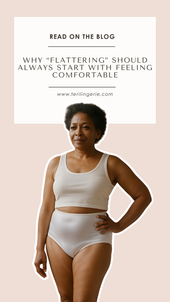
Forget the number on the tag. What matters is finding pieces that fit comfortably, flatter your shape, and make you feel confident.
Ready to find your new favorites?
Shop flattering, comfortable essentials at terilingerie.com and find styles made for feeling good in what you wear.

Leave a comment